
Getting a Florida driver license is one of the first things to sort out when you settle in Miami, and in 2026 something important changed: exams are now given in English only. If you're coming from another country, it helps to know from the start which tests apply to your current license, what documents to bring and where to book an appointment in Miami-Dade. Here's all of it, with the official sources.
When you need a Florida license
While you're visiting, Florida law lets you drive on a valid license from your home country or state, as long as you carry it and meet the state's lawful presence requirements.
That changes once you settle. If you start a job, practice a trade or profession, or enroll your children in a Florida public school, you have 30 days to get a Florida license. The same deadline applies to your spouse and children who drive. There are limited exceptions, for example for active-duty military and some students.
Which exams apply to your license
This is what varies most from person to person. Florida waives exams for drivers from places it has agreements with:
| Your current license | Knowledge exam | Skills test |
|---|---|---|
| Another U.S. state or territory | Waived | Waived |
| Canada, France, Taiwan or South Korea | Waived | Waived |
| Germany | Required | Waived |
| Any other country (including Latin America and Spain) | Required | Required |
| Never licensed (age 18 or older) | Required, plus the TLSAE course | Required |
If you're from Canada and use the waiver, you'll have to surrender your Canadian license. If you'd rather keep it, you can take both exams. Everyone takes a vision test, and the waiver list can change: confirm it when you book.
The TLSAE course (Traffic Law and Substance Abuse Education) takes 4 hours and is required for anyone 18 or older who has never held a license in any state or country. If you already drive on a home-country license, it usually isn't required, but bring that license to prove it.
English-only exams: what changed
Since February 6, 2026, the Florida Department of Highway Safety and Motor Vehicles (FLHSMV) gives all driver license exams in English only, statewide, including at authorized third-party providers. Printed exams in other languages are gone, and translators and interpreters are no longer allowed, including during the skills test.
The good news is that the official Florida driver handbook is still available in Spanish. A practical way to prepare:
- Study the handbook in your language first, so you fully understand the rules.
- Then review it in English, paying attention to sign and question vocabulary (yield, right-of-way, school zone…).
- Take practice tests in English until you read the questions comfortably.
- For the skills test, learn the basic instructions the examiner will give (turn left, pull over, back up…).
The knowledge exam
The Class E knowledge exam (for a regular car license) has 50 multiple-choice questions on traffic laws and road signs. To pass you need 40 correct answers, or 80%.
Only applicants under 18 can take it online. Adults take it in person, at a driver license office or with a state-authorized third-party provider.
The driving skills test
During the skills test, the examiner will ask for a series of maneuvers, including:
- a three-point turn;
- straight-in parking;
- parking on a grade;
- backing up 50 feet;
- obeying stop signs and signals;
- keeping a four-second following distance.
You provide the car, and it must have a valid registration, proof of insurance and pass a basic inspection. If, for example, a headlight is out or the tag is expired, the test won't go ahead. Skills tests are only offered at some offices or authorized providers, so check when you book.
What documents to bring
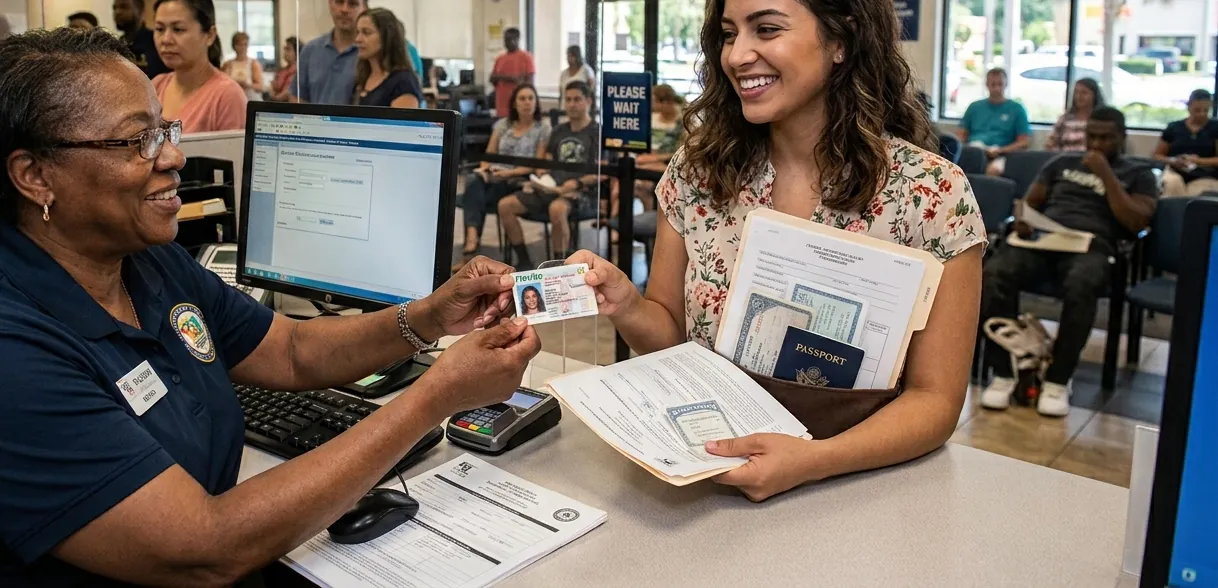
You'll need originals or certified copies of:
- Identity and legal status: for citizens, a U.S. passport or birth certificate. For non-citizens, your immigration documents, such as a green card, an employment authorization card or a passport with Form I-94.
- Social Security number: your card or another official document showing it, such as a W-2 or pay stub. Some visa holders who aren't eligible for a number must bring a Social Security letter confirming it.
- Two proofs of a Florida address, from two different sources: lease, recent utility bill, car insurance policy, bank mail…
- If your name has changed, for example through marriage, documents linking your birth name to your current one.
- Your current license, whether from another state or your home country.
If your immigration status is temporary, the license is issued for the period authorized by U.S. Citizenship and Immigration Services (USCIS) and shows the word TEMPORARY in red.
Where and how to book in Miami-Dade
In Miami-Dade, driver licenses are now handled by the county Tax Collector's offices. The transition has happened in phases, so some offices may still be run by the state (FLHSMV).
- Book only through the official website of the Miami-Dade Tax Collector (mdctaxcollector.gov). Some sites charge to “get” you an appointment: you don't need them.
- Offices already run by the county also take walk-ins during business hours, and some open on Saturday mornings.
- Skills tests are only offered at some offices. Choose one that offers them if you need it.
What it costs
| Item | Cost |
|---|---|
| Class E license (first time) | $48 |
| Service fee at Tax Collector offices | Up to $6.25 |
| TLSAE course, if required | Varies by provider |
| Knowledge or skills exam with a private provider | Varies by provider |
FLHSMV fees, checked in October 2026. They can change: confirm them before you go.
Common mistakes
- Studying only in your own language. The exam is in English: practice in English too.
- Showing up with one proof of address. You need two, from different sources, with a Florida address.
- Bringing an uninsured or faulty car to the skills test. The test won't go ahead.
- Booking through unofficial websites. Appointments are free on the Tax Collector's site.
- Missing the 30-day window after starting work or enrolling your children.
- Leaving your home-country license at home. Without it, you may be asked to take the TLSAE course as if you'd never driven.
FAQ
Can I take the exam in Spanish?
No. Since February 6, 2026, all exams are in English, with no interpreters or translators. You can study with the official handbook in Spanish, but the exam itself is in English.
My license is from Spain or Latin America. Do I need to test?
Yes. Right now, Florida only waives exams for licenses from other U.S. states and territories, Canada, France, Taiwan and South Korea, and the skills test for German licenses. Confirm when you book in case the list changes.
Can I keep driving on my current license while I get the Florida one?
As a visitor, yes, if it's valid and you meet the lawful presence requirements. Once you start working or enroll your children, you have 30 days to get a Florida license. Also check with your insurer that your license is valid for your policy.
Can I take the knowledge exam online from home?
Only if you're under 18. Adults take it in person, at an office or with an authorized provider.
Do I need a Social Security number?
Generally, yes: proof of the number is required. Some visa holders who aren't eligible for a number must bring a Social Security letter confirming it. If you're unsure about your case, ask when you book.
Next step
Your license is just one item on your first months' to-do list. Our guide to moving to Miami covers the rest, with every deadline: car insurance and registration (due sooner, within 10 days), Social Security, banking, schools and hurricanes.
Sources
- Florida Statutes § 322.031: Nonresident; when license required (via Florida Public Law)
- Florida Statutes § 322.04: Persons exempt from obtaining driver license (via Florida Public Law)
- FLHSMV: New Florida residents
- FLHSMV: Class E knowledge exam and driving skills test
- FLHSMV: What to bring (non-immigrants)
- FLHSMV: What to bring, frequently asked questions
- FLHSMV: Fees
- Hillsborough County Tax Collector: Statewide policy change, driver license exams in English only from February 6
- Orange Observer: Florida moving to English-only driver license exams
- WFLA: Florida's English-only driver's license exam, what to know
- Palm Beach County Tax Collector: Transfer an out-of-state or out-of-country driver license
- Palm Beach County Tax Collector: Traffic Law and Substance Abuse Education (TLSAE)
- Miami-Dade Tax Collector: Driver license and ID card services transition
- FLHSMV: Official Florida driver handbook (English, PDF)