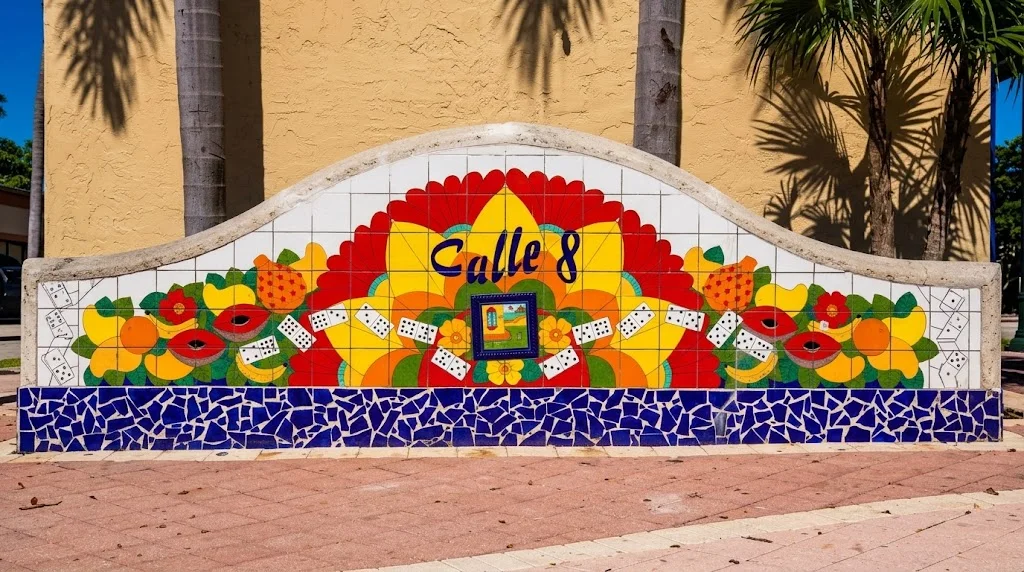
Little Havana is where Miami sounds like Cuba: coffee at the ventanita, domino games in the shade, colorful murals and Calle Ocho as its backbone. Since the 1960s it has been the gateway for tens of thousands of Cuban exiles and, later, for Nicaraguans, Hondurans and other Latin Americans. Today it is also one of the lowest-rent neighborhoods near downtown. Here is what living in Little Havana is like and, with official data, what it costs, how its schools perform and what to know about flooding.
What is Little Havana like in numbers?
Little Havana is a City of Miami neighborhood without its own Census boundary, so we use ZIP code 33135, which covers the heart of the neighborhood on both sides of Calle Ocho, between SW 12th and SW 37th Avenues. The eastern part of the neighborhood, closer to the river, is in ZIP code 33130, which it shares with western Brickell, and we leave it out to avoid mixing very different realities. Figures come from the Census Bureau (American Community Survey, 2020-2024 average) unless otherwise noted.
| Metric | Little Havana (ZIP 33135) | Miami-Dade |
|---|---|---|
| Population | 36,143 | 2,738,356 |
| Residents per km² of land | 6,571 | 557 |
| Median gross rent per month | $1,422 | $1,829 |
| Median value of owner-occupied homes | $418,500 | $463,000 |
| Median household income | $40,567 | $71,753 |
| Owner-occupied households | 22.7% | 52.2% |
| Adults with a bachelor's degree or higher | 21.7% | 34.4% |
| Foreign-born residents | 73.3% | 54.5% |
| Speak Spanish at home | 91.4% | 66.7% |
| Under 18 | 16.7% | 20.0% |
| People per household | 2.41 | 2.76 |
| Average commute | 31.6 min | 30.9 min |
| Households without a car | 22.7% | 9.8% |
| Single-family homes | 34.2% | 48.7% |
| Median year built | 1960 | 1980 |
| Renters spending over 30% of income on rent | 65.0% | 60.9% |
| Land in a high-risk flood zone (FEMA) | 5.9% | 33.8% in the City of Miami |
These are five-year medians: current listings are usually higher. We explain each figure in the method note.
What is it like to live in Little Havana?
Before it was Little Havana, this area was the Riverside and Shenandoah neighborhoods: in the 1930s, a middle-class Southern neighborhood with a thriving Jewish community. Everything changed in the 1960s, when tens of thousands of Cubans arrived fleeing the Castro regime. By 1970, more than 85% of residents were Cuban, and the neighborhood took the name it is known by around the world. Many families later moved to other parts of Miami, but Little Havana remained the first home for new arrivals: since the late 1990s, also for Nicaraguans, Hondurans and other Central Americans. In 2017, the National Trust for Historic Preservation declared it a National Treasure.
That history lives on the street. Almost everything here happens in Spanish: 91% of residents speak it at home, and almost three in four were born outside the U.S. Cubans make up 46% of the population, followed by Nicaraguans at 12% and Hondurans at 10%. It is a neighborhood of working people and families, with grandparents playing dominoes, neighbors who have known each other for decades and newcomers starting their life in Miami here.
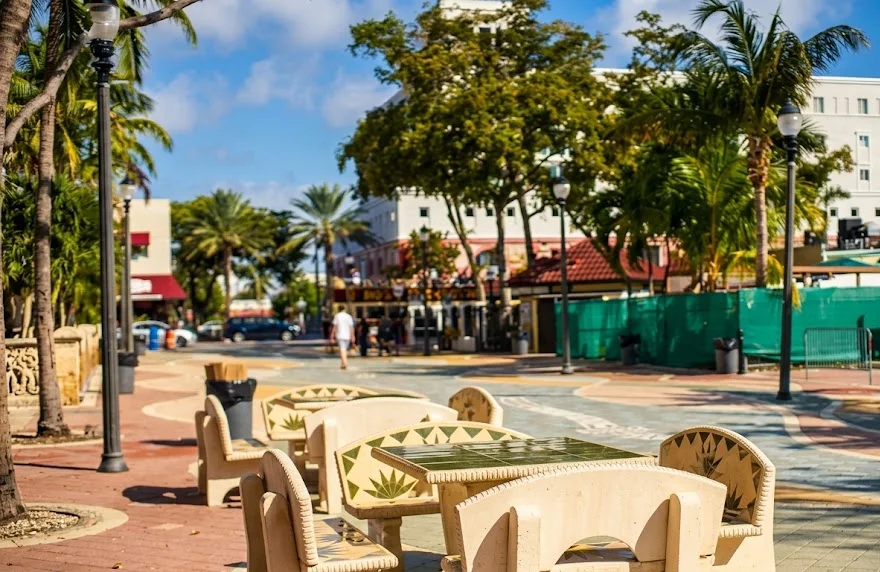
It is also a dense, lively neighborhood, with low-rise houses and small apartment buildings from the 1950s and 1960s, corner shops, cafés with walk-up windows and a lot of street life, especially around Calle Ocho and Flagler Street.
What is there to do in Little Havana?
Where to eat
- Versailles, on Calle Ocho since 1971, the classic meeting place of Miami's Cuban community, with its mirrors and its coffee window.
- Sanguich de Miami, Cuban sandwiches in a small Calle Ocho luncheonette, with a Bib Gourmand, MICHELIN's award for good value.
- Cafés and ventanitas on every corner, where you order a cafecito or a cortadito and some pastelitos.
As always, check recent reviews, because things change.
Strolling and history
- Máximo Gómez Park, known as Domino Park, at Calle Ocho and SW 15th Avenue, where residents have gathered to play dominoes since the 1970s. It is named after the general who led Cuba's liberation army.
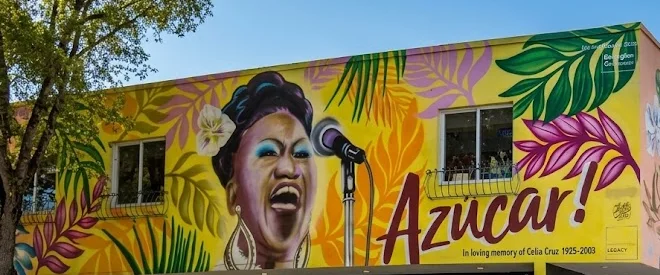
- The Calle Ocho Walk of Fame, between SW 12th and 17th Avenues, with stars honoring Latin artists such as Celia Cruz and Gloria Estefan.
- The Tower Theater, a 1926 movie house, remodeled in Art Deco style in 1931, which in 1960 became the first in Miami to add Spanish subtitles.
- Cuban Memorial Boulevard, on SW 13th Avenue, with the eternal flame honoring the members of Brigade 2506 who died at the Bay of Pigs in 1961, and a sacred ceiba tree.
For the weekend
- The Calle Ocho festival, the main event of Carnaval Miami, with music and dance on several stages along 15 blocks of Calle Ocho, between SW 12th and 27th Avenues. It is free, and the next edition is on March 14, 2027.
- Viernes Culturales, an arts, music and food fair on Calle Ocho on the last Friday of each month. Check the calendar, as it may vary.
- CubaOcho, a museum and cultural center on Calle Ocho, with Cuban art from 1800 to 1958 and live music.
How much does it cost to live in Little Havana?
Little Havana is a neighborhood of renters: almost eight in ten households rent. A third of homes are single-family houses, and most of the rest are duplexes and small apartment buildings, with a median year built of 1960, among the oldest in this series.
- Renting: the median rent is $1,422 a month, the lowest of the neighborhoods we have analyzed and about $400 below the county. Even so, 65% of renters spend more than 30% of their income on rent, because local wages are low. If you have no credit history, read how to rent in Miami without a credit history.
- Buying: the median value is $418,500, below the county. In older buildings, check the condition of the wiring, plumbing and roof, because they affect insurance. We explain it in our guide to buying property in Miami.
Current price: According to Zillow, in September 2026 the typical value of a house in Little Havana was $605,000 (+1.9% over a year) and of a condo, $277,000 (−2.1%). We compare it with other areas, along with rent and flood insurance, in Miami home prices by area, updated every month. Work out what it would cost you to live here →
How good are the schools in Little Havana?
ZIP code 33135 has 3 public schools graded by the Florida Department of Education. In 2026, 2 earned an A and 1 a B:
| School | Grades | 2026 grade |
|---|---|---|
| Shenandoah Elementary | PK-5 | A |
| Miami Senior High | 9-12 | A |
| Auburndale Elementary | PK-5 | B |
According to the county registry, there are also 5 charter schools and 15 private schools, including several in the Lincoln-Martí network.
How do you get around Little Havana?
- Free trolley: the City of Miami trolley's Little Havana route stops at Domino Park and connects with the Brickell Metrorail and Metromover station. It runs from 6:30 a.m. to 11 p.m. on weekdays and Saturdays, and from 8 a.m. to 8 p.m. on Sundays.
- Bus and Metrorail: there are no Metrorail stations in the ZIP code; bus lines on Calle Ocho and Flagler Street run to downtown and Brickell.
- Car: 22.7% of households have no car, more than twice the county rate. Brickell and downtown are about ten minutes away by car, and State Road 836 leads to the airport.
Is Little Havana safe?
According to the FBI, the City of Miami police recorded 358 violent crimes and 2,243 property crimes per 100,000 residents in 2025. The U.S. averages that year were 330 and 1,552. Violent crime is 9% above the national average, and it fell 26% from 2024.
The FBI publishes data by police department, so this is the figure for the whole City of Miami, not just Little Havana: the city includes very different areas.
Within each area, risk changes from one street to the next: visit by day and by night before deciding. Compare it with other areas in Miami crime rates by area.
Does Little Havana flood?
- Flood zone: according to FEMA's current map, only 5.9% of the ZIP code's land is in a high-risk zone, almost all of it in zone AH, the ponding zone. It is the lowest share of the neighborhoods we have analyzed.
- Hurricane evacuation: 87% of the land is in storm surge zone E, the last to evacuate, and 13% in zone B.
Even though the risk is low, some streets pond during heavy rain. Before renting or buying, look up the exact address on the FEMA flood map and ask for the flood disclosure required by Florida law.
What are the pros and cons of Little Havana?
| Pros | Cons |
|---|---|
| The lowest rent in this series, close to downtown | Old buildings, often with minimal upkeep |
| Life in Spanish, culture and community | Low incomes and heavy rent pressure on residents |
| The lowest flood risk in the series | Few large parks |
| Free trolley to Brickell | No Metrorail in the neighborhood |
| Two A-rated public schools | Tourism and noise on Calle Ocho, especially during festivals |
Who is Little Havana right for?
A good fit if: you have just arrived in Miami and want affordable rent near downtown, want to live in Spanish and in community, work in Brickell or downtown, or are drawn to Cuban and Latin American culture.
Maybe not for you if: you want new buildings with amenities, a quiet green neighborhood, a mainly English-speaking environment or large parks close to home.
Similar neighborhoods: if you like living in Spanish but want newer homes and A-rated schools, read our Doral guide; if you want to be next door, with more services and transit, our Brickell guide; and if you want houses with yards at a moderate price, our Kendall guide.
Want to compare them all? Read our guide to Miami neighborhoods: where to live based on what you want.
FAQ
Where is Little Havana?
It is a City of Miami neighborhood west of downtown and Brickell, roughly between SW 3rd and SW 37th Avenues, and between NW 7th Street and Coral Way. Its main street is Calle Ocho (SW 8th Street).
How much does it cost to rent in Little Havana?
The Census median rent in ZIP code 33135 is $1,422 a month (2020-2024), the lowest of the neighborhoods we have analyzed. Current listings are usually higher.
Is Little Havana safe?
As in any big-city neighborhood, it depends on the street. Before renting, visit the area at different times of day and check the Miami Police Department's crime data.
Does Little Havana flood?
It is among the lowest-risk neighborhoods: only 5.9% of the ZIP code's land is in a high-risk zone according to FEMA, and 87% is in evacuation zone E, the last to evacuate. Some streets pond during heavy rain.
When is the Calle Ocho festival?
The next edition is on Sunday, March 14, 2027, on Calle Ocho between SW 12th and 27th Avenues. Admission is free.
Method note
Because Little Havana has no Census boundary of its own, we use ZIP code 33135 (Census ZIP Code Tabulation Area), which lies within the neighborhood and covers its central and western part, between SW 12th and SW 37th Avenues. Population, housing, income, language, origin and commuting figures come from the U.S. Census Bureau's American Community Survey (2020-2024 five-year average). Density is our own calculation, on land area, excluding water. The shares of land in flood and evacuation zones are our own calculations, overlaying that boundary with FEMA's current flood map and the storm surge zones published by Miami-Dade County, on land area. Schools are located using county open data, and school grades are the Florida Department of Education's official 2026 grades. The restaurant distinction is from the 2026 MICHELIN Guide Florida.
Sources
- U.S. Census Bureau: American Community Survey 5-year estimates, 2020-2024 (ZCTA 33135, Miami-Dade County)
- Florida Department of Education: 2026 School Grades
- Miami-Dade County Open Data: FEMA flood zones, storm surge planning zones and schools
- Little Havana
- Greater Miami Convention & Visitors Bureau: 12 historic sites in Little Havana
- Greater Miami Convention & Visitors Bureau: Calle Ocho Music Festival
- Greater Miami Convention & Visitors Bureau: Best Cuban sandwiches in Miami
- Tower Theater (Miami, Florida)
- Máximo Gómez Park
- MICHELIN Guide: Florida's Bib Gourmand restaurants in 2026
- City of Miami: Trolley information
- FEMA: Flood Map Service Center