Some neighborhoods you visit, and some you can picture yourself living in. Coral Gables is the second kind: tree-shaded avenues, red tile roofs and cream-colored facades, the sound of fountains in its plazas and a pace that invites you to slow down. It has been called the City Beautiful for a century, and you can tell its residents look after it. In this guide we tell you what life is like here, where to eat, what to do on an ordinary Saturday and, with official data, what it costs, how its schools perform and which risks are worth knowing before you move.
What is Coral Gables like in numbers?
We compare Coral Gables with Miami-Dade County as a whole. Unless stated otherwise, figures come from the Census Bureau (American Community Survey, 2020-2024 average).
| Figure | Coral Gables | Miami-Dade |
|---|---|---|
| Population | 49,802 | 2,738,356 |
| Median gross rent per month | $2,373 | $1,829 |
| Median value of owner-occupied homes | $1,089,900 | $463,000 |
| Median household income | $134,216 | $71,753 |
| Households earning over $200,000 a year | 37.0% | 11.6% |
| Owner-occupied households | 64.5% | 52.2% |
| Adults with a bachelor's degree or higher | 73.6% | 34.4% |
| Foreign-born | 37.7% | 54.5% |
| Speak Spanish at home | 51.6% | 66.7% |
| Under 18 | 17.2% | 20.0% |
| Average commute | 23.8 min | 30.9 min |
| Households without a car | 6.3% | 9.8% |
| Renters spending over 30% of income on rent | 49.1% | 60.9% |
| Tree canopy (county, 2020) | 44.1% | 16.4% in the City of Miami |
| Land in a FEMA high-risk flood zone | 38.7% | 33.8% in the City of Miami |
These are five-year medians: current rental and sale listings usually run higher. We explain how each figure was calculated in the methodology note at the end of this guide.
What is it like to live in Coral Gables?
Coral Gables was born from a dream. In the early 20th century, George Merrick imagined a Mediterranean-inspired garden city, and on April 29, 1925, it became a city. He called it the City Beautiful, and a hundred years later the name still fits: 44% of its land is covered by trees, almost three times the City of Miami, and on many streets the trees form a green roof over the road.
That beauty is carefully protected. The city has a Board of Architects that reviews every new home and commercial building, expansions, pools, signs and even roof tiles, and publishes lists of approved paint colors. For residents, that means a harmonious setting that doesn't deteriorate over time; for anyone planning a renovation, a bit more patience.
Daily life is calm and neighborly. In the morning you'll see residents walking their dogs under the trees, families heading to school and students on their way to the University of Miami, whose main campus is here. At midday, downtown fills with professionals: Coral Gables is home to plenty of offices and firms, and its residents spend seven fewer minutes commuting than the county average. And as evening falls, the terraces on Giralda and Miracle Mile take over.
Residents are mostly professionals and established families: 74% of adults hold a bachelor's degree, compared with 34% in the county, and almost one in five is 65 or older. You'll hear Spanish everywhere, though less than in other parts of Miami: half of residents speak it at home, so it's easy to feel at home in either language.
What is there to do in Coral Gables?
What makes people fall for Coral Gables isn't just its homes, but everything within a short walk of them.
Where to eat
Coral Gables is one of Miami's most interesting dining areas, and the MICHELIN Guide agrees:
- Shingo, a 14-seat Japanese omakase with one MICHELIN star, the only one in the city.
- Zitz Sum, Asian cooking with Colombian roots, awarded a MICHELIN Bib Gourmand, the distinction for places offering great value.
- Tinta y Café, a classic Cuban café, also with a Bib Gourmand: perfect for a cafecito and a sandwich mid-morning.
For everyday dining, Giralda, turned into a pedestrian plaza, is lined with restaurants with outdoor tables, and Miracle Mile brings together shops, cafés and restaurants of every kind. Openings change fast, so check the MICHELIN Guide and recent reviews before you go.
Strolls and the outdoors
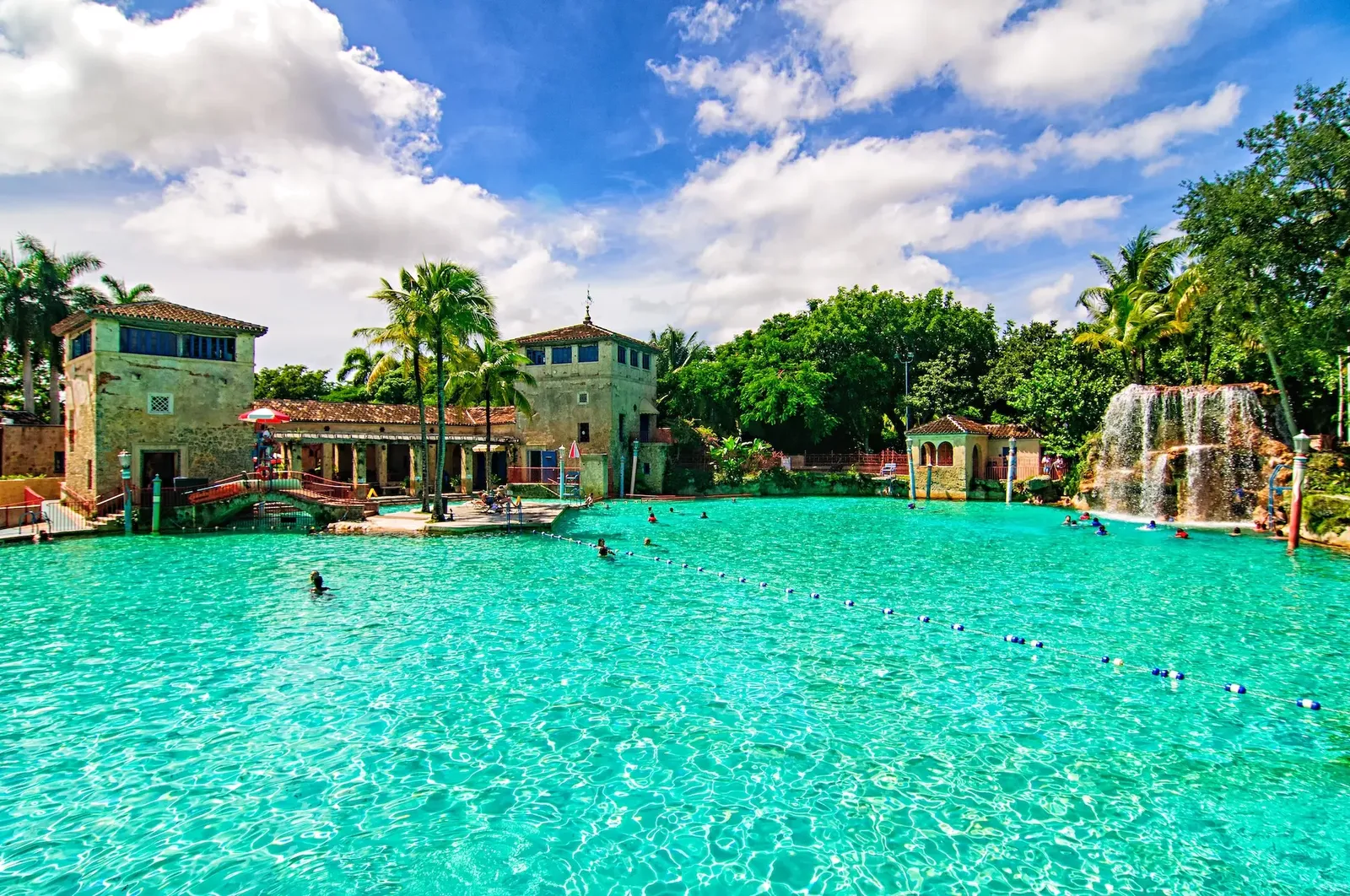
- The Venetian Pool, a public pool opened in 1924 in the old limestone quarry that supplied stone for the city, with waterfalls, grottoes and stone towers. It's fed by artesian wells, drained daily and listed on the National Register of Historic Places since 1981. A swim there is something you won't forget.
- Fairchild Tropical Botanic Garden, about 83 acres of palms, tropical plants and a butterfly conservatory on Old Cutler Road.
- Matheson Hammock, a county park on the bay with mangroves, trails and a natural saltwater pool fed by the tides.
For the weekend
- The farmers market, on Saturday mornings in front of City Hall during the winter season (January to March in 2026).
- Books & Books, an independent bookstore founded in 1982 in a historic 1927 building, with a courtyard café and author events.
- Golf: the city's Granada course, with 9 holes and opened in 1923, the oldest operating course of its kind in Florida, and the Biltmore course, designed by Donald Ross.
- The Biltmore Hotel, built in 1926 and a National Historic Landmark since 1996, worth a visit even if you're not staying.
How much does it cost to live in Coral Gables?
Coral Gables is above all a city of houses: just over half of its homes are single-family, and almost two in three households own their home. The housing stock is older, with a median year built of 1969, alongside apartment towers downtown and along Ponce de Leon Boulevard.
- Buying: the median value is over a million dollars, more than double the county's. Before buying, read our guide to buying property in Miami as a foreigner, especially the insurance and flooding sections.
- Renting: the median rent is $2,373 a month. Interestingly, fewer renters here are stretched by rent than in the rest of the county: 49% spend over 30% of their income on it, compared with 61% in Miami-Dade, because incomes are higher. If you have no credit history, read renting in Miami without a credit history.
Current price: According to Zillow, in September 2026 the typical value of a house in Coral Gables was $2,097,000 (+9.8% over a year) and of a condo, $567,000 (+1.3%). We compare it with other areas, along with rent and flood insurance, in Miami home prices by area, updated every month. Work out what it would cost you to live here →
How good are the schools in Coral Gables?
Coral Gables has 7 public schools graded by the Florida Department of Education, all in the Miami-Dade district, which earned an A in 2026. These are their 2026 grades:
| School | Grades | 2026 grade |
|---|---|---|
| George Washington Carver Elementary | Pre-K to 5 | A |
| Coral Gables Preparatory Academy | Pre-K to 8 | A |
| Henry S. West Laboratory School | K to 8 | A |
| George Washington Carver Middle | 6 to 8 | A |
| Ponce de Leon Middle | 6 to 8 | B |
| International Studies Preparatory Academy | 9 to 12 | A |
| Coral Gables Senior High | 9 to 12 | B |
According to the county registry, the city also has 1 charter school and 18 private schools.
How do you get around Coral Gables?
- Car: the usual way to get around: only 6% of households don't have one. The average commute is 24 minutes, seven less than the county average.
- Metrorail: University station is inside the city, next to the campus. Douglas Road station sits on the boundary, in the City of Miami.
- Free trolley: the city runs a free trolley along Ponce de Leon Boulevard, from Douglas Road station to Flagler Street, Monday to Saturday, 6:30 a.m. to 10 p.m. It doesn't run on Sundays or some holidays. In November 2025, a pilot service extending it south began.
Is Coral Gables safe?
According to the FBI, the Coral Gables police recorded 61 violent crimes and 999 property crimes per 100,000 residents in 2025. The U.S. averages that year were 330 and 1,552. Violent crime is 81% below the national average, and it rose 17% from 2024.
Within each area, risk changes from one street to the next: visit by day and by night before deciding. Compare it with other areas in Miami crime rates by area.
Does Coral Gables flood?
It's the least talked-about side of Coral Gables and the one that matters most for your insurance.
- Flood zone: according to FEMA's current map, 38.7% of the city's land is in a high-risk zone, where flood insurance is required if you have a mortgage. The risk isn't the same everywhere. By our calculation, in the southern half, roughly south of US-1, where the bayfront and canal neighborhoods are, 69% of the land is high-risk; north of Bird Road, only 8%.
- Hurricane evacuation: according to the county's storm surge planning zones, 44% of the land is in zone A, the first to evacuate, along the coast. Another 30% is in zone C and 22% in zone E.
Before renting or buying, look up the exact address on the FEMA flood map and ask for the flood disclosure the landlord or seller must give you under Florida law.
What are the pros and cons of Coral Gables?
| Pros | Cons |
|---|---|
| Tree-lined streets and a very well-kept setting | One of the most expensive places in the county to buy |
| Good public schools: 5 of 7 rated A | More rules and paperwork to renovate your home |
| Shorter commutes than the county average | Car-dependent, except near the trolley or Metrorail |
| Quiet, residential and historic, with MICHELIN-level restaurants | Little nightlife compared with Brickell, Wynwood or Miami Beach |
| University, hospitals and offices close by | High flood risk in the southern half, near the bay |
Who is Coral Gables right for?
It's a good fit if: you dream of a house with a garden under the trees, want good schools for your children, enjoy great food and an unhurried stroll, work in Coral Gables, at the University of Miami or in Brickell, and your budget allows it.
It may not be for you if: your budget is tight, you want to live without a car, you want the beach on your doorstep or late nights out, or you'd rather renovate without going through the city's design rules.
Similar neighborhoods: if you like Coral Gables but want something different, look at Coconut Grove, also green and on the bay, or Kendall, more affordable and also family-friendly. And if you want A-rated schools and life in Spanish, read our Doral guide.
Curious about Miami's most exclusive side? Read how many millionaires live in Miami, with the data and its caveats.
Want to compare them all? Read our guide to Miami neighborhoods: where to live based on what you want.
Frequently asked questions
Is Coral Gables part of Miami?
It's in the Miami area, but it's an independent city within Miami-Dade County, with its own city hall, police department and zoning rules.
How much does it cost to rent in Coral Gables?
The Census median rent is $2,373 a month (2020-2024). Current listings usually run higher, depending on the area and type of home.
Are Coral Gables public schools good?
In 2026, 5 of its 7 graded public schools earned an A and the other 2 a B. Remember that your assigned school depends on your address.
Does Coral Gables flood?
38.7% of its land is in a FEMA high-risk zone, mostly in the southern half, near the bay and canals. Always check the exact address before renting or buying.
Can you live in Coral Gables without a car?
It's possible near Ponce de Leon Boulevard, with the free trolley and Metrorail, but most residents drive.
Methodology note
Population, housing, income, language and commuting figures come from the U.S. Census Bureau's American Community Survey (2020-2024 five-year estimates) for the City of Coral Gables. We calculated the shares of land in flood zones and evacuation zones ourselves by overlaying the official city boundary (Census TIGER) on FEMA's current flood map and the storm surge planning zones, both published by Miami-Dade County, using land area only, excluding water. To compare the north and south of the city, we split its area into approximate latitude bands at Bird Road and US-1. School grades are the Florida Department of Education's official 2026 grades; schools are located using the county registry. Tree canopy is the county's published figure for 2020.
Sources
- U.S. Census Bureau: American Community Survey 5-year estimates, 2020-2024 (Coral Gables city, Miami-Dade County)
- Florida Department of Education: 2026 School Grades
- Miami-Dade County Open Data: FEMA flood zones
- Miami-Dade County Open Data: Storm surge planning zones
- Miami-Dade County Open Data: Urban tree canopy by municipality, 2016-2020
- Miami-Dade County Open Data: Public, charter and private schools
- U.S. Census Bureau: TIGERweb boundaries
- City of Coral Gables: Board of Architects
- City of Coral Gables: Trolley
- The Cultural Landscape Foundation: Venetian Pool
- The Cultural Landscape Foundation: The Biltmore Hotel
- NBC Miami: Coral Gables celebrates its centennial (2025)
- FEMA: Flood Map Service Center
- MICHELIN Guide: Coral Gables restaurants
- Haute Living: The best restaurants in Coral Gables (August 2026)
- City of Coral Gables: Fairchild Tropical Botanic Garden
- The Cultural Landscape Foundation: Matheson Hammock Park
- City of Coral Gables: Golf
- City of Coral Gables: Farmers market
- University of Miami: Books & Books in Coral Gables