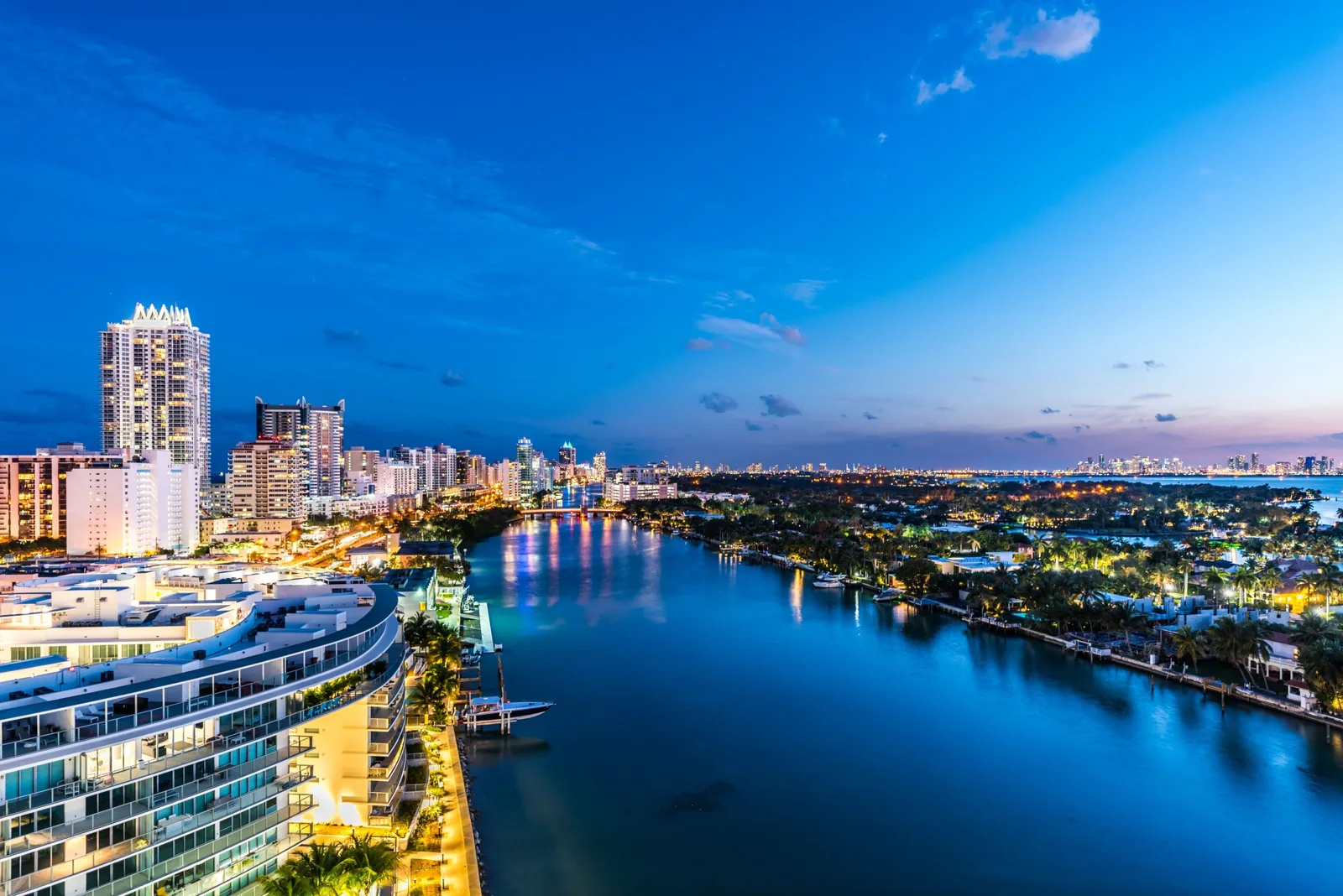
Buying luxury property in Miami as a foreigner is legal and common: according to MIAMI Realtors, international buyers account for 15% of residential sales volume in South Florida, and more than half pay cash. What changes compared with a local buyer isn't your right to buy, but the taxes, how you hold the property and what happens when you sell or pass it on. Here's the process step by step, with official sources, so you arrive at your first viewing knowing what to ask.
Can a foreigner buy?
Yes. In the United States you don't need to be a citizen or resident, or hold a visa, to buy a home, and you can close from your home country with a power of attorney and remote signing. Two limits are worth knowing from the start:
- Buying doesn't give you residency. Owning property doesn't give you the right to live in the U.S. The investment route, the EB-5 visa, requires investing at least $800,000 in targeted employment areas, or $1,050,000 elsewhere, in a business that creates 10 jobs. A personal home doesn't qualify.
- Florida's "countries of concern" law. Since July 2023, chapter 692 of the Florida Statutes restricts purchases by people and entities linked to China, Russia, Iran, North Korea, Cuba, Venezuela and Syria. For an individual domiciled in one of those countries, the law limits purchases near military installations and critical infrastructure, and allows buying a single home of up to 2 acres more than 5 miles from a military installation, with a non-tourist visa or asylum documentation and in their own name. That purchase must then be registered with the Florida Department of Commerce. In practice, every buyer signs an affidavit at closing.
If you're from Cuba or Venezuela, or your company has ties to any of those countries, talk to a Florida real estate attorney before making an offer.
The process, step by step
- Decide the structure before you search. In your name, jointly or through a company: it changes taxes, privacy and inheritance. Talk to an attorney and an accountant who work with foreign buyers.
- Choose an agent and sign a buyer agreement. Since August 17, 2024, an agent must sign a written agreement with you before showing you a home, and it sets their compensation.
- Make an offer. The contract sets the price, the escrow deposit, the deadlines for inspection and financing, and the closing date.
- Check everything before you commit: inspection, flood zone and insurance quote, the building's documents and finances if it's a condo, and the title search, which confirms no one else has rights to the property.
- Close with a title company or attorney. The deed is signed, funds are paid and the deed is recorded with the county. Buying title insurance is standard.

In your name or through an LLC
| Option | Pros | Keep in mind |
|---|---|---|
| In your name | Simplest; easier to finance | Your name is in the public record; the home counts toward U.S. estate tax |
| Florida LLC | More privacy; separates the property from your personal assets | Registered agent, annual report and, if you're foreign, Form 5472 every year; harder to finance |
| Other structures (foreign companies, trusts) | Can reduce estate tax exposure | Costly and complex: only with international tax advice |
If you choose an LLC, we explain how to open a Florida LLC as a non-resident and what Form 5472 requires.
Cash or financing
Most international buyers in Miami pay cash. If you finance, there are loans for foreign nationals, but they usually require a larger down payment and a higher interest rate than for a resident, and you'll need to document income and assets in your home country.
However you pay, the bank and title company will ask you to document the source of funds. A federal rule that would have required reporting all-cash purchases made through companies was vacated by a Texas court in March 2026, but those checks are still standard. To move money from your country, compare the real cost of the transfer first in our money transfer comparison.

Taxes and costs at purchase
| Item | How much | Who pays |
|---|---|---|
| Documentary stamp tax on the deed in Miami-Dade | $0.60 per $100 for single-family homes; $1.05 for everything else, including condos | Negotiable; in Florida the seller usually pays |
| Documentary stamp tax on the mortgage | $0.35 per $100 of the loan | The buyer, if financing |
| Intangible tax on the mortgage | 0.2% of the loan | The buyer, if financing |
| Title insurance, closing, inspections and attorney | Depends on the price and the professionals | Negotiated in the contract |
On a $2 million condo, the documentary stamp tax on the deed is $21,000. Always ask the title company for a closing estimate before you sign the contract.
What you pay every year
- Property tax. In Miami-Dade's luxury areas, the total 2025 rate ranges from about 15.5 mills in Key Biscayne to about 20 mills in the City of Miami: $15,500 to $20,000 a year per million of taxable value. A nonresident can't claim the homestead exemption, and their taxable value can rise up to 10% a year, excluding the school portion. On November 3, 2026, Florida votes on Amendment 3, which would lower that cap to 5% from 2027 if approved.
- Insurance. Homeowners, wind and flood, which in Miami are often separate. We explain it in our guide to home and flood insurance.
- Building or association fees, and maintenance.
We work through examples in the true cost of owning luxury property in Miami.
If you buy in a tower
Since 2022, Florida law requires condo buildings three or more stories tall to pass a structural milestone inspection at 30 years and every 10 years after, and to complete a reserve study every 10 years, funding the repairs it identifies. Before buying in a tower, ask for:
- the latest milestone inspection and reserve study;
- the association's budget and financials, including any loans for repairs;
- special assessments approved or planned;
- the building's rules on rentals, pets and renovations.
A building with low reserves can mean special assessments of tens of thousands of dollars per unit.
If you plan to rent it out
By default, the IRS taxes rent received by a nonresident at 30% of the gross amount, withheld by the payer. You can elect to be taxed on net income instead, deducting expenses, by filing Form 1040-NR every year and giving the payer Form W-8ECI. For that you need a taxpayer identification number: see our guide to the ITIN.
Also check city and building rules: many buildings ban short-term rentals.
When you sell or pass it on
- FIRPTA. When the seller is foreign, the buyer must withhold 15% of the price if it exceeds $1 million and send it to the IRS. It isn't the final tax: it's reconciled on your return, and you can apply for reduced withholding in advance.
- Estate tax. If a nonresident dies with more than $60,000 in U.S. assets, the IRS requires Form 706-NA, and U.S. real estate counts. Some tax treaties change this rule. It's the point most buyers discover too late.
Thinking about buying in Miami?
Tell us what you are looking for in two minutes. A person will reply, in English or Spanish, to point you in the right direction and, if you ask, put you in touch with licensed professionals.
- Free, no obligation
- We never sell your data
- We only share it if you ask
If you haven't chosen an area yet, compare neighborhoods in our guide to Miami neighborhoods, with guides to Key Biscayne, Coral Gables, Pinecrest and Sunny Isles Beach. For context, read how many millionaires live in Miami.
Frequently asked questions
Can a foreigner buy a house in Miami?
Yes. You don't need to be a citizen or resident, or hold a visa. The exception is people linked to seven countries that a 2023 Florida law treats as "of concern," including Cuba and Venezuela, who face restrictions.
Does buying property in Miami give me residency?
No. The EB-5 investor visa requires investing at least $800,000 or $1,050,000 in a business that creates 10 jobs; a personal home doesn't qualify.
Can Venezuelans and Cubans buy property in Florida?
With limits if they're domiciled in Venezuela or Cuba: they can buy a single home of up to 2 acres, away from military installations, with a non-tourist visa or asylum documentation and in their own name, and must register it. Talk to a Florida attorney before making an offer.
Is it better to buy through an LLC?
It gives you privacy and separates the property from your assets, but it has annual obligations and makes financing harder. On its own it doesn't solve estate tax. Decide with an attorney and an accountant before you search.
How much is property tax in Miami?
In luxury areas, roughly $15,500 to $20,000 a year per million of taxable value, depending on the municipality, at 2025 rates. A nonresident can't claim the homestead exemption.
What is FIRPTA?
The federal law that requires the buyer to withhold part of the price when the seller is foreign: 15% if the sale exceeds $1 million. That money is reconciled later on the seller's tax return.
Method note
This guide summarizes information from the IRS, U.S. Citizenship and Immigration Services (USCIS), the Florida Department of Revenue, the Miami-Dade Property Appraiser, the Florida Statutes and MIAMI Realtors, reviewed in October 2026. Property tax rates combine the Property Appraiser's proposed 2025 rates with the municipal rates finally adopted, and are approximate. This guide is general information, not legal, tax or financial advice: every case depends on your country of residence and applicable treaties.
Sources
- MIAMI REALTORS: 2025 International Report (PDF)
- IRS: FIRPTA withholding
- IRS: Some nonresidents with U.S. assets must file estate tax returns
- IRS: Taxation of nonresident aliens
- Florida Department of Revenue: Documentary stamp tax
- Florida Statutes, chapter 692, part III: conveyances to foreign entities
- Florida Realtors: Website helps certain foreign land owners register
- USCIS: EB-5 Immigrant Investor Program
- Miami-Dade Property Appraiser: 2025 proposed millage rate comparison (PDF)