Fort Lauderdale is the largest city in Broward County, about 28 miles north of Miami: beach, canals everywhere, a downtown of new towers along the river and Las Olas Boulevard. It is smaller and calmer than Miami, with prices close to the Miami-Dade average and below Brickell, and connected to it by train. Here is what living in Fort Lauderdale is like and, with official data, what it costs, how its schools rate, what the crime figures say and what to know about flooding.
What is Fort Lauderdale like in numbers?
Fort Lauderdale is an independent city and the seat of Broward County, so we use its official Census boundary and compare it with the county. These are U.S. Census Bureau figures (American Community Survey, 2020-2024 average) unless otherwise noted.
| Figure | Fort Lauderdale | Broward County |
|---|---|---|
| Population | 185,604 | 1,977,129 |
| Median gross rent per month | $1,854 | $1,907 |
| Median value of owner-occupied homes | $486,700 | $414,600 |
| Median household income | $83,130 | $77,633 |
| Households earning $200,000 or more a year | 15.8% | 12.2% |
| Owner-occupied households | 54.1% | 63.6% |
| Adults with a bachelor's degree or higher | 40.8% | 36.7% |
| Foreign-born | 27.0% | 36.9% |
| Hispanic or Latino | 20.3% | 32.8% |
| Speak Spanish at home | 17.7% | 28.5% |
| Under 18 | 17.3% | 20.8% |
| People per household | 2.25 | 2.60 |
| Average commute | 26.1 min | 29.1 min |
| Households without a car | 8.2% | 6.8% |
| Single-family homes | 39.2% | 48.7% |
| Homes in buildings with 20 or more units | 37.6% | 28.8% |
| Median year built | 1973 | 1980 |
| Renters spending more than 30% of income on rent | 55.6% | 61.9% |
| Land in a high-risk flood zone (FEMA) | 61.9% | — |
These are five-year medians: current listings are usually higher. We explain each figure in the method note.
What is it like to live in Fort Lauderdale?
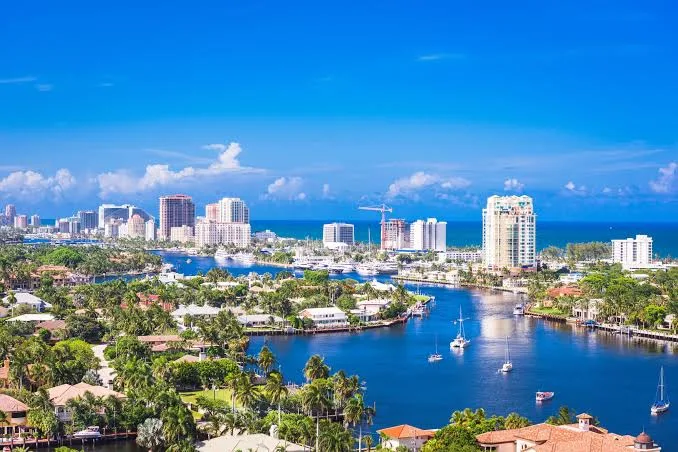
The city is named after the forts the army built here in 1838, during the Second Seminole War, under Major William Lauderdale. It was incorporated in 1911 and grew with the canal dredging of the 1920s, which turned mangroves into residential islands with private docks. That is why it is known as the "Venice of America": according to the county tourism office, there are about 165 miles of waterways inside the city.
It is a city of contrasts. Along the New River is downtown, with new office and apartment towers; to the east, across the Intracoastal, the beach strip with hotels and condos; and in between, neighborhoods of 1950s and 1960s houses, many on canals. Some areas worth knowing:
- Downtown and Flagler Village: rental apartment towers, close to the Brightline station and the riverfront promenade.
- Victoria Park, Colee Hammock and Rio Vista: neighborhoods of houses under big trees, minutes from downtown and Las Olas.
- Las Olas Isles, Harbor Beach and Coral Ridge: waterfront houses with docks, among the most expensive in the city.
- The beach and Galt Ocean Mile: oceanfront condo buildings, many from the 1960s and 1970s.
- The northwest and southwest: more affordable neighborhoods, with more single-family houses and fewer tourists.
It is less Latin than Miami. One in five residents is Hispanic, compared with one in three in Broward, and the largest group is Cuban (3.7% of the population), followed by Puerto Ricans (2.8%), Colombians (2.2%), Mexicans (1.7%), Venezuelans (1.6%) and Guatemalans (1.6%). Other origins are also significant: nearly 29% of residents are Black or African American, a share similar to the county; 5.9% of residents report Haitian ancestry and 3.9% Jamaican, and Irish (8.7%), German (7.1%) and Italian (6.6%) ancestry are common. English dominates on the street, although Spanish is easy to find in shops and county services.
It is a city of adults more than families with children: households are small, only 17% of residents are under 18 and nearly half of households rent. There are more high-income households than in the rest of the county, but also lower-income neighborhoods. Jobs rely on tourism, Port Everglades, the marine industry, health care, with Broward Health Medical Center as the main hospital, and downtown and county government offices.
What is there to do in Fort Lauderdale?
Life revolves around the water: the beach, the canals and the river. The highlights:
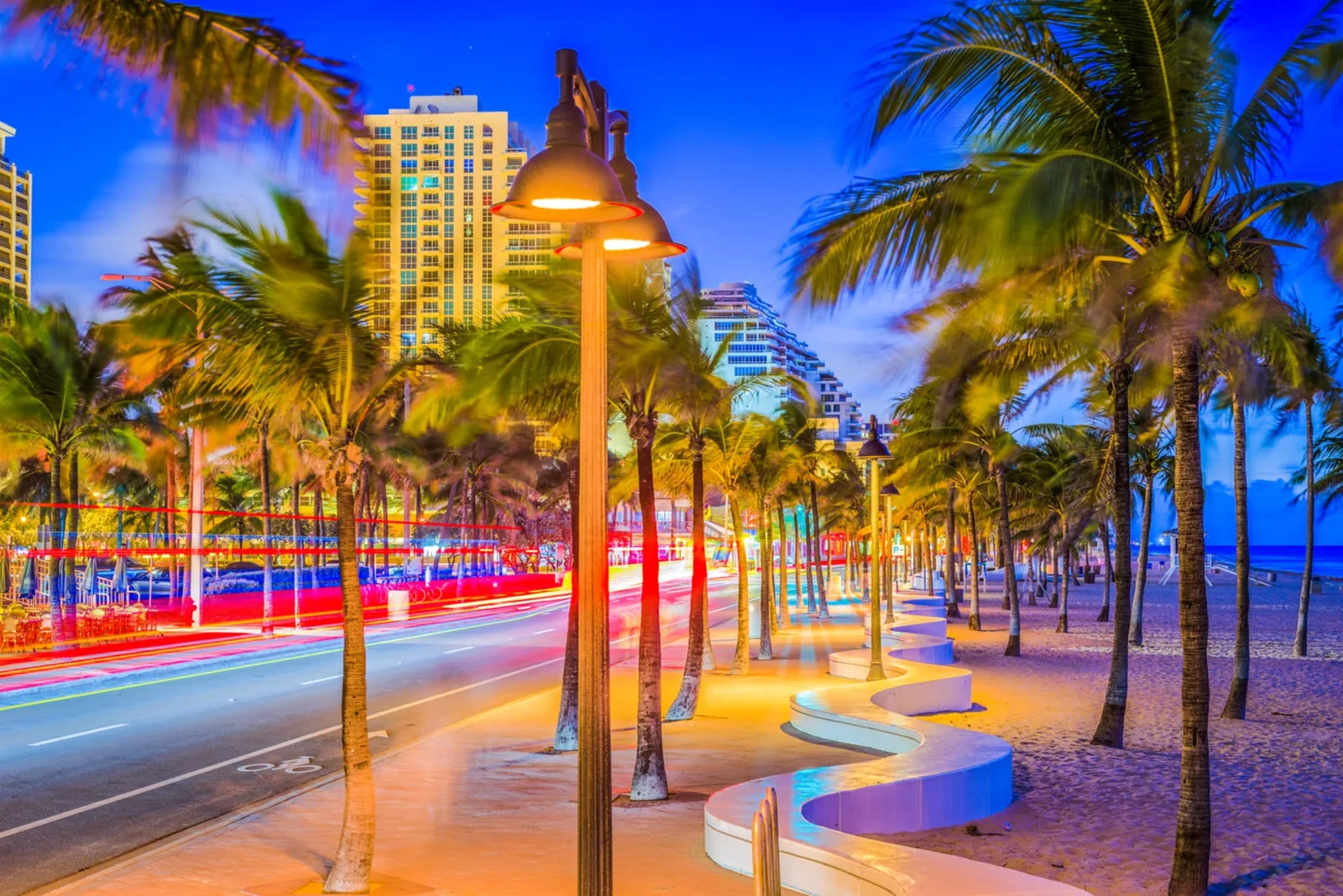
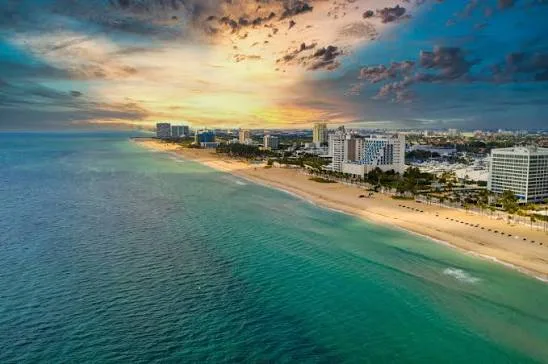
- Fort Lauderdale Beach: the city has about 7 miles of beaches. The A1A promenade, with its white wave wall and palm trees, is the best known, with bars and restaurants across the street.
- Las Olas Boulevard: the street of shops, galleries and sidewalk restaurants that links downtown with the beach.
- Riverwalk: the promenade along the New River downtown, connecting restaurants, museums and the Broward Center for the Performing Arts, the city's main theater.
- Hugh Taylor Birch State Park and Bonnet House: a state park and a historic estate with 35 acres of gardens, both between the ocean and the Intracoastal, with original coastal vegetation.
- Boats: the Water Taxi runs through the canals and, every fall, the city hosts the Fort Lauderdale International Boat Show, one of the largest boat shows in the world. Port Everglades, on the city's southern edge, is one of the country's major cruise ports.
How much does it cost to live in Fort Lauderdale?
There is a bit of everything: apartments in new downtown towers, older oceanfront condos, 1950s houses in quiet neighborhoods and waterfront mansions. Only 39% of homes are single-family houses, and more than a third are in buildings with 20 or more units.
- Renting: the Census median rent, $1,854 a month, is close to the county average because it includes older leases and cheaper neighborhoods. Current listings are considerably higher: according to Zillow, the typical rent was around $2,700 a month in September 2026. If you have no credit history, read how to rent in Miami without a credit history.
- Buying: the median value is $486,700, above the county. With condos, check the association fees and the building's condition: many date from the 1960s and 1970s, and since 2022 Florida has required structural inspections and repair reserves, which have pushed fees up. We explain it in our guide to buying property in Miami.
- Property tax: the city's rate is 4.12 mills, plus 0.23 for its debt, compared with 3.35 in Weston or 7.14 in the City of Miami. Adding the county, schools and other authorities, the total is about 18.45 mills, roughly $1,845 a year per $100,000 of taxable value, and somewhat more downtown, where the Downtown Development Authority is added. If it is your primary residence, the homestead exemption takes up to $50,000 off the value (the second $25,000 does not apply to school taxes). The bill may also include flat fees for services such as garbage or the fire assessment.
- Insurance: the average home policy in Broward costs $6,136 a year with wind coverage, and a condo unit policy $1,816, according to Florida's regulator. See how it changes by home in how much home insurance costs.
Current price: According to Zillow, in September 2026 the typical value of a house in Fort Lauderdale was $587,000 (+0.1% over a year) and of a condo, $403,000 (−1.5%). We compare it with other areas, along with rent and flood insurance, in Miami home prices by area, updated every month. Work out what it would cost you to live here →
Before deciding, also check how much you need to earn to live in Fort Lauderdale and how much home insurance costs in the area.
How good are the schools in Fort Lauderdale?
Public schools belong to Broward County Public Schools. Within city limits there are 23 public schools graded in the Florida Department of Education's official 2026 grades: 16 earned an A, 4 a B and 3 a C. That is somewhat better than the district as a whole, where 62% of graded schools earned an A.
| School | Level | 2026 grade |
|---|---|---|
| Bayview Elementary | Elementary | A |
| Croissant Park Elementary | Elementary | A |
| Dillard Elementary | Elementary | A |
| Floranada Elementary | Elementary | A |
| Harbordale Elementary | Elementary | A |
| North Fork Elementary | Elementary | A |
| North Side Elementary | Elementary | A |
| Rock Island Elementary | Elementary | A |
| Stephen Foster Elementary | Elementary | A |
| Sunland Park Academy | Elementary | A |
| Virginia Shuman Young Elementary | Elementary | A |
| Westwood Heights Elementary | Elementary | A |
| Bennett Elementary | Elementary | B |
| Walker Elementary | Elementary | B |
| Riverland Elementary | Elementary | C |
| Thurgood Marshall Elementary | Elementary | C |
| New Life Charter Academy | Charter | A |
| Sunrise Middle | Grades 6-8 | A |
| New River Middle | Grades 6-8 | B |
| William Dandy Middle | Grades 6-8 | B |
| Fort Lauderdale High | Grades 9-12 | A |
| Stranahan High | Grades 9-12 | A |
| Dillard 6-12 | Grades 6-12 | C |
Some of these schools have magnet programs that students from other areas can apply to, and depending on the address, the zoned school may be in a neighboring city. Well-known private schools in the city include Pine Crest School and St. Thomas Aquinas High School, a Catholic school.
How do you get around Fort Lauderdale?
- Car: still the most practical option; 8.2% of households do not have one. I-95 runs through the city north to south, and US-1 and A1A run along the coast. The average commute is 26.1 minutes, shorter than in the county.
- Brightline: the high-speed train has a downtown station a few blocks from the Broward Center. It reaches Miami in about 35 minutes and also serves Aventura, Boca Raton, West Palm Beach and Orlando, among others.
- Tri-Rail: the commuter train, cheaper and slower, has two stations in the city, Fort Lauderdale and Cypress Creek, and another next to the airport. It runs south to Miami International Airport (some trains continue to downtown Miami) and north into Palm Beach County.
- Airport and port: Fort Lauderdale-Hollywood International Airport (FLL) sits right at the city's southern edge, with Port Everglades next to it.
- On the water and downtown: the city runs the free LauderGO! Water Trolley, a boat along the New River and the Riverwalk (the city is considering charging visitors), and a Community Shuttle bus. The paid Water Taxi links downtown with the beach through the canals.
- To Miami: it is about 28 miles to Downtown Miami. By car, I-95 gets very congested at rush hour; the train is usually more predictable.
Is Fort Lauderdale safe?
According to the FBI, the Fort Lauderdale police recorded 672 violent crimes and 3,290 property crimes per 100,000 residents in 2025. The U.S. averages that year were 330 and 1,552. In other words, violent crime is twice the national average, although it fell 2% from 2024, and property crime fell 19%. It is the highest rate among the areas we analyze with data: the City of Miami recorded 359 violent crimes per 100,000 residents.
The figure needs context. The rate is calculated on residents, but Fort Lauderdale receives millions of tourists, cruise passengers and many people who work downtown, who are not counted as residents, and that mainly inflates theft. Crime is also concentrated in some areas: the city has very quiet neighborhoods and others with much more crime.
Before deciding, visit the area by day and by night, and check the Fort Lauderdale police crime map for the exact address. Compare it with other areas in Miami crime rates by area.
Does Fort Lauderdale flood?
It is the city's biggest weakness. Fort Lauderdale is low, flat and surrounded by water.
- Flood zone: according to FEMA's current map, 61.9% of the land is in a high-risk zone: 52.8% in zone AE, 8.6% in zone AH, for shallow ponding, and 0.5% in zone VE, exposed to waves. Another 24.6% is in a moderate-risk zone.
- Flood insurance is very common: the city has more than 12,000 policies from the federal program (NFIP), and 87% are in a high-risk zone. The median policy costs $1,267 a year, although it varies a lot by home.
- The April 2023 storm: on April 12, 2023, about 26 inches of rain fell in 24 hours at the airport, most of it in about six hours, according to preliminary National Weather Service data. Streets and homes flooded and the airport stayed closed until Friday.
- King tides: during the highest fall tides, water can rise through storm drains on some streets along the canals and the Intracoastal, even without rain.
- Hurricane evacuation: in Broward, people east of the Intracoastal or next to tidal water and low-lying areas evacuate as early as a Category 1 or 2 hurricane, and people east of US-1 in a Category 3 or higher. A good part of Fort Lauderdale is in those areas.
Before renting or buying, check the exact address on the FEMA flood map, ask whether the home has flooded and get a flood insurance quote. We explain how to get covered in our guide to home and flood insurance in Miami.
What are the pros and cons of Fort Lauderdale?
| Pros | Cons |
|---|---|
| Beach, canals and outdoor life | 62% of the land in a high-risk flood zone |
| High-speed train to Miami and the airport next door | Violent crime rate twice the national average |
| More urban life than Broward's suburbs | Many older condos with rising fees |
| Moderate city tax rate | Less Latin atmosphere and less Spanish on the street than Miami |
| Most of its public schools rated A | Big differences between neighborhoods, schools included |
Who is Fort Lauderdale right for?
It suits you if: you want to live near the beach or the water, you like having restaurants and street life without Miami's size, you work in Broward or from home, you split your time between Miami and Palm Beach, or you have a boat or want one.
It may not be for you if: you do not want to worry about flooding or insurance, you want a setting where Spanish is spoken every day, or you prefer a suburb of newer houses, such as Weston.
Similar areas: for beach and oceanfront buildings inside Miami-Dade, read our guide to Miami Beach or the one on Sunny Isles Beach; for an urban core with a train, the one on Brickell; and to stay in Broward but in a family suburb, the one on Weston.
To compare every area, read our guide to Miami neighborhoods: where to live based on what you want, and work out how much you need to earn with the salary needed to live in Miami.
Frequently asked questions
Is Fort Lauderdale part of Miami?
No. Fort Lauderdale is an independent city and the seat of Broward County, about 28 miles north of Downtown Miami. It is part of the Miami metropolitan area, but not of Miami-Dade County.
Is Fort Lauderdale dangerous?
The city's violent crime rate, 672 per 100,000 residents in 2025 according to the FBI, is twice the national average, although it fell 2% in 2025. Tourists, who are not counted as residents, mainly push up theft, and crime is concentrated in some areas: there are very quiet neighborhoods. Visit the area by day and by night and check the police crime map before deciding.
Is it cheaper to live in Fort Lauderdale than in Miami?
Cheaper than Brickell, but similar to Miami Beach and the Miami-Dade average, and pricier than the rest of Broward: the typical asking rent is around $2,700 a month according to Zillow, and the median home value is $486,700 according to the Census. Home insurance in Broward costs slightly more than in Miami-Dade ($6,136 vs. $5,975 a year), but a condo unit policy is much cheaper ($1,816 vs. $2,801).
Is it better to live in Fort Lauderdale or Miami?
It depends on what you want. Fort Lauderdale is smaller and calmer, with beach, canals and a human-scale downtown, and less Spanish is spoken. Miami has more jobs, more culture and nightlife and a much more Latin feel. If you work in Miami, living near Brightline in Fort Lauderdale is a reasonable option; otherwise, compare area by area in our guide to Miami neighborhoods.
Are there many Latinos in Fort Lauderdale?
Fewer than in Miami or the rest of Broward: 20.3% of residents are Hispanic and 17.7% speak Spanish at home, according to the Census. The largest groups are Cuban, Puerto Rican and Colombian. For a more Latin setting in Broward, cities such as Weston or Pembroke Pines have a larger Hispanic presence.
Does Fort Lauderdale flood?
Yes, it is its biggest risk. 61.9% of the land is in a high-risk zone according to FEMA, and in April 2023 about 26 inches of rain fell in a single day. Always check the exact address and get a flood insurance quote before signing.
How do you get from Fort Lauderdale to Miami?
Brightline, the high-speed train, takes about 35 minutes from downtown Fort Lauderdale to Downtown Miami. Tri-Rail is cheaper and slower. By car it is about 28 miles on I-95, with heavy traffic at rush hour.
What is the ZIP code for Fort Lauderdale?
According to the 2020 Census ZIP Code Tabulation Areas, Fort Lauderdale is mainly in ZIP codes 33312, 33311, 33309 and 33308, and to a lesser extent 33315, 33304, 33316, 33301, 33305, 33334 and 33306. ZIP codes do not always follow city limits: for a specific address, check the USPS ZIP code lookup.
Method note
We use the City of Fort Lauderdale's official Census boundary. Population, housing, income, language, origin, race, ancestry and commuting figures come from the U.S. Census Bureau's American Community Survey (2020-2024 five-year average), compared with Broward County. Haitian and Jamaican ancestry is as reported by residents, and a person can report more than one. The share of land in flood zones is our own calculation, overlaying that boundary with FEMA's current flood map, on land area. The list of schools comes from overlaying the locations of public schools from the National Center for Education Statistics (NCES, 2024-2025 school year) with that boundary, and the grades are the Florida Department of Education's official 2026 grades; we do not include ungraded centers, such as adult education or special programs. Crime figures are those the Fort Lauderdale police reported to the FBI. The property tax is the sum of the final 2025 rates published by the Broward County Property Appraiser for the city. The city's history comes from public sources.
Sources
- U.S. Census Bureau: American Community Survey 5-year estimates (2020-2024)
- National Center for Education Statistics: public school locations 2024-2025 (EDGE)
- Florida Department of Education: 2026 school grades
- FBI: Crime Data Explorer
- FEMA: National Flood Hazard Layer
- FEMA: Flood Map Service Center
- OpenFEMA: FIMA NFIP Redacted Policies (data.gov catalog)
- Broward County Property Appraiser: 2025 final millage rates (PDF)
- Florida Office of Insurance Regulation: Property Insurance Stability Report, July 2026 (PDF)
- Broward County: hurricane evacuation information
- City of Fort Lauderdale: LauderGO! Water Trolley
- Tri-Rail: Broward County stations
- VISIT FLORIDA: Brightline trains in Florida
- Visit Lauderdale: the Venice of America
- WFLX / National Weather Service: more than 25 inches of rain floods Fort Lauderdale (April 2023)
- Axios Miami: Fort Lauderdale airport reopens after historic rainfall (April 2023)