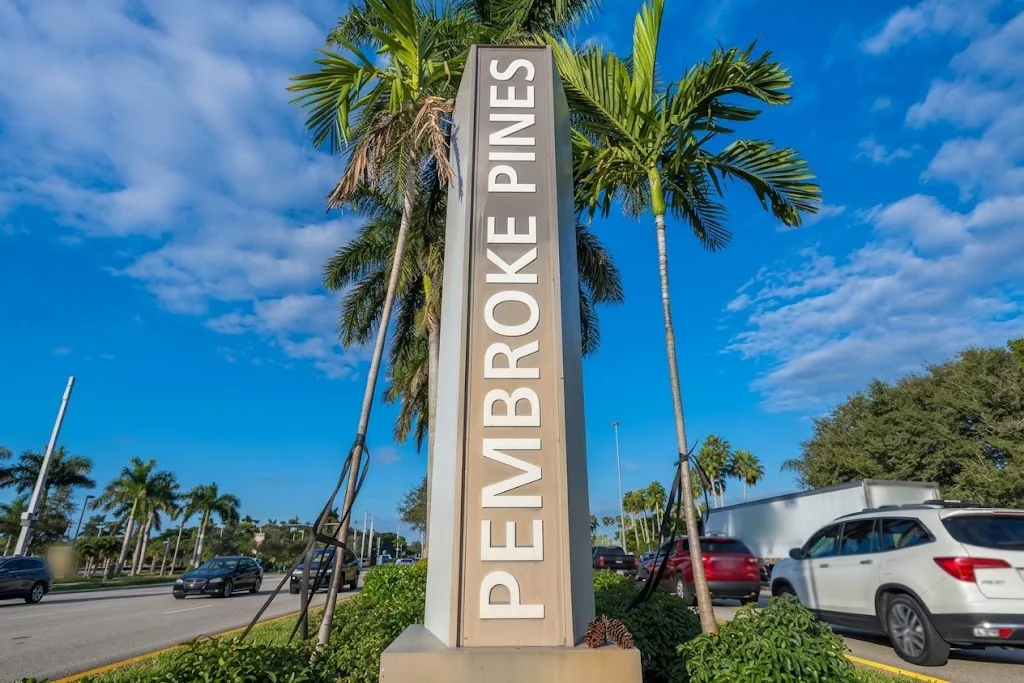
Pembroke Pines is the second most populous city in Broward County, about 22 miles from Downtown Miami: a large suburb of houses with yards, lakes and shopping centers, where half of residents are Hispanic. It has something almost no other U.S. city has, its own charter school system, and condos cheaper than in Miami-Dade. Here is what living in Pembroke Pines is like and, with official data, what it costs, how its schools rate and what to know about flooding.
What is Pembroke Pines like in numbers?
Pembroke Pines is an independent city in Broward County, so we use its official Census boundary and compare it with the county. These are U.S. Census Bureau figures (American Community Survey, 2020-2024 average) unless otherwise noted.
| Figure | Pembroke Pines | Broward County |
|---|---|---|
| Population | 173,194 | 1,977,129 |
| Median gross rent per month | $2,046 | $1,907 |
| Median value of owner-occupied homes | $439,500 | $414,600 |
| Median household income | $85,104 | $77,633 |
| Owner-occupied households | 69.6% | 63.6% |
| Adults with a bachelor's degree or higher | 39.7% | 36.7% |
| Foreign-born | 40.5% | 36.9% |
| Hispanic or Latino | 50.0% | 32.8% |
| Speak Spanish at home | 44.6% | 28.5% |
| Under 18 | 18.8% | 20.8% |
| 65 and over | 20.0% | 17.9% |
| People per household | 2.66 | 2.60 |
| Average commute | 30.4 min | 29.1 min |
| Households without a car | 6.6% | 6.8% |
| Single-family homes | 59.9% | 48.7% |
| Median year built | 1992 | 1980 |
| Renters spending more than 30% of income on rent | 62.6% | 61.9% |
| Land in a high-risk flood zone (FEMA) | 60.2% | — |
These are five-year medians: current listings are usually higher. We explain each figure in the method note.
What is it like to live in Pembroke Pines?
Where there are subdivisions today, there were dairies seventy years ago: western Broward was cheap, flat dairy farmland. The city was incorporated in 1960 and first grew in the east, near US-441, with houses from the 1960s and 1970s. The big leap came from the 1980s and 1990s, when development pushed west to I-75 and the edge of the Everglades. That is why half of the homes were built in 1992 or later, newer than in the rest of the county.
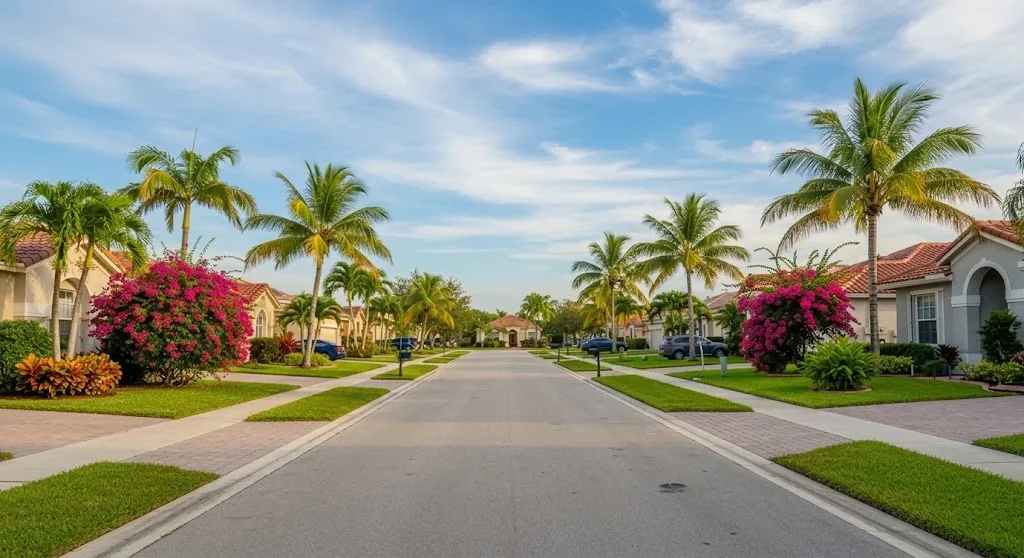
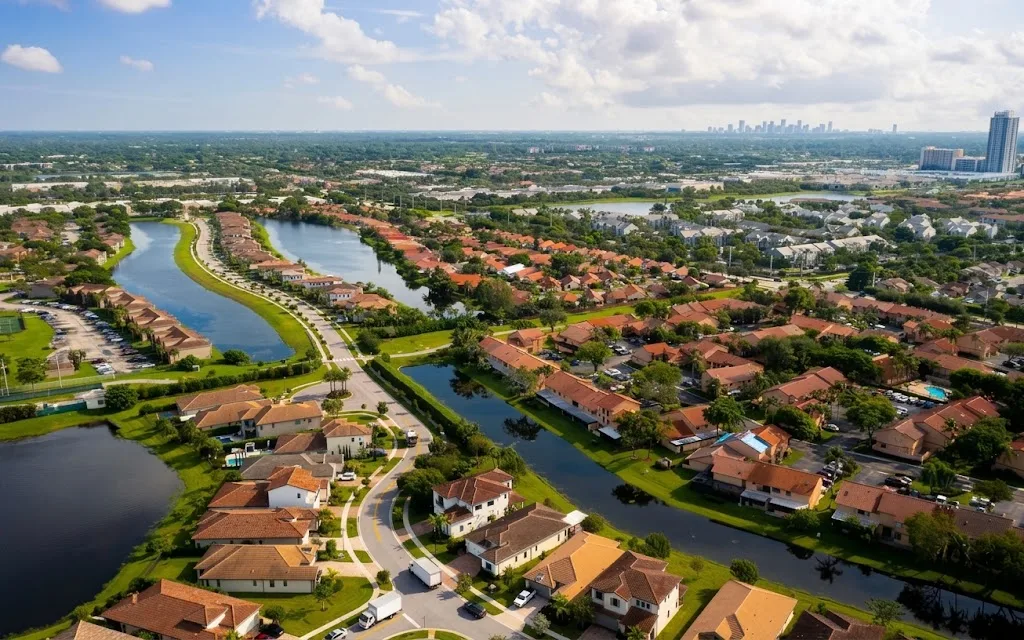
It is a suburb of houses with yards, man-made lakes, wide streets and shopping centers, with many communities governed by homeowners associations, some of them gated. Three worlds coexist: young families in the western communities, such as Silver Lakes or Chapel Trail; older, more affordable neighborhoods in the east; and a large retired population. One in five residents is 65 or older, largely because of Century Village, a huge condo complex for people 55 and over.
And it is one of the most Latino cities in Broward. Half of residents are Hispanic: Cubans (15.0% of the population), Colombians (7.7%), Puerto Ricans (6.4%), Venezuelans (6.0%), Dominicans (3.2%) and Peruvians (2.4%), among others. Spanish is heard everywhere, from the supermarket to the doctor's office. One in five residents is Black or African American.
The city is well served: it has two hospitals of the public Memorial system, Memorial Hospital West and Memorial Hospital Pembroke, which are also major employers, and Broward College's south campus.
What is there to do in Pembroke Pines?
Leisure is family-oriented and outdoors, with plenty of shopping. The highlights:
- C.B. Smith Park: a county park of about 300 acres with a lake, trails, courts, a campground and the Paradise Cove water park, open seasonally.
- Shopping: the Pembroke Lakes Mall and The Shops at Pembroke Gardens, an open-air center with shops and restaurants.
- Culture and sports: the Charles F. Dodge City Center, with concerts and shows, an ice rink and a wide network of city parks with courts and sports fields.
- Nature: the Everglades lie just west of the city.
For the beach, Hollywood Beach and Fort Lauderdale are about 25 to 30 minutes away by car, without traffic.
How much does it cost to live in Pembroke Pines?
Six in ten homes are single-family houses, and 70% of households own their home. The rest are condos and rental apartments, many in complexes with a pool and amenities.
- Renting: the Census median rent is $2,046 a month, above the county, because there are many recent houses and apartments. Current listings are higher: according to Zillow, the typical rent was around $2,570 a month in September 2026. If you have no credit history, read how to rent in Miami without a credit history.
- Buying: the typical house is worth about $590,000 and the typical condo about $187,000, according to Zillow, compared with $599,000 and $347,000 in Miami-Dade: houses cost about the same, but condos are much cheaper. Many of the cheap condos are in 55-and-over communities, with their own rules: under federal law, at least 80% of occupied units must have a resident aged 55 or older, and many do not allow children to live there. Check before making an offer. Most communities have a homeowners association, with fees and rules: ask for the bylaws and the monthly fee before deciding. We explain it in our guide to buying property in Miami.
- Property tax: the city's rate is 5.67 mills, plus 0.29 for its debt. Adding the county, schools and other authorities, the total is about 18.89 mills, roughly $1,889 a year per $100,000 of taxable value. If it is your primary residence, the homestead exemption takes up to $50,000 off the value (the second $25,000 does not apply to school taxes). The bill may also include flat fees for services such as garbage or the fire assessment.
- Insurance: the average home policy in Broward costs $6,136 a year with wind coverage, and a condo unit policy $1,816, according to Florida's regulator. See how it changes by home in how much home insurance costs.
Current price: According to Zillow, in September 2026 the typical value of a house in Pembroke Pines was $590,000 (−0.6% over a year) and of a condo, $187,000 (−6.4%). We compare it with other areas, along with rent and flood insurance, in Miami home prices by area, updated every month. Work out what it would cost you to live here →
Before deciding, also check how much you need to earn to live in Pembroke Pines and how much home insurance costs in the area.
How good are the schools in Pembroke Pines?
Schools are one of the city's strengths. Within city limits there are 27 public schools graded in the Florida Department of Education's official 2026 grades: 22 earned an A, 4 a B and 1 a C. That is better than Broward's district as a whole, where 62% earned an A.
Nearly half are charter schools, public and free but independently run. And there is a twist: the city itself runs its own charter school system. It created it in 1998, when county schools were badly overcrowded, and today it covers elementary through high school. Charter schools usually require an application and, if there are more applicants than seats, hold a lottery.
| School | Type and level | 2026 grade |
|---|---|---|
| Chapel Trail Elementary | District, elementary | A |
| Lakeside Elementary | District, elementary | A |
| Palm Cove Elementary | District, elementary | A |
| Pembroke Lakes Elementary | District, elementary | A |
| Pembroke Pines Elementary | District, elementary | A |
| Pines Lakes Elementary | District, elementary | A |
| Silver Palms Elementary | District, elementary | A |
| Pasadena Lakes Elementary | District, elementary | B |
| Panther Run Elementary | District, elementary | B |
| Silver Trail Middle | District, grades 6-8 | A |
| Walter C. Young Middle | District, grades 6-8 | A |
| Pines Collegiate Academy | District, grades 6-12 | A |
| Charles W. Flanagan High | District, grades 9-12 | A |
| West Broward High | District, grades 9-12 | A |
| Pembroke Pines Charter Elementary | City charter | A |
| City/Pembroke Pines Charter Middle | City charter | A |
| City/Pembroke Pines Charter High | City charter | A |
| Somerset Academy | Charter | A |
| Somerset Academy Middle | Charter | A |
| Somerset Academy Charter High | Charter | A |
| Somerset Arts Conservatory | Charter | A |
| Franklin Academy Pembroke Pines | Charter | A |
| Franklin Academy (campus F) | Charter | A |
| Renaissance Charter Middle School at Pines | Charter | A |
| Franklin Academy Pembroke Pines High | Charter | B |
| Renaissance Charter Schools at Pines | Charter | B |
| Atlantic Montessori Charter School | Charter | C |
How do you get around Pembroke Pines?
- Car: essential; only 6.6% of households do not have one. Pines Boulevard crosses the city east to west, I-75 runs along the west side, and Florida's Turnpike passes nearby to the east. The average commute is 30.4 minutes.
- To Miami: Downtown Miami is about 22 miles away. At rush hour, I-75 and the Turnpike get congested: if you will work in Miami, try the commute at that hour before deciding.
- Airports: Fort Lauderdale (FLL) is about 15 miles away, and Miami (MIA) about 22. The city is home to North Perry, a small general aviation airport.
- Public transit: county buses run along the main avenues, but there is no train. The nearest Tri-Rail stations are in Hollywood.
Is Pembroke Pines safe?
Pembroke Pines has a reputation as a quiet city, but we do not give a crime figure: the data the city police reported to the FBI for 2024 and 2025 are clearly incomplete. For example, 2024 shows only 5 violent crimes in a city of more than 170,000 people, and 76 for 2025, far below what a city this size would report. We do not know why, so we prefer not to use them.
As in any large city, risk varies from one area to another. Visit the area by day and by night before deciding, and check the Pembroke Pines police information for the exact address. Compare other areas in Miami crime rates by area.
Does Pembroke Pines flood?
- Flood zone: according to FEMA's current map, 60.2% of the land is in a high-risk zone: 53.2% in zone AE, where FEMA sets how high water can rise in a major flood, and 7.0% in zone AH, for shallow ponding. Almost all the rest, 34.8%, is in a moderate-risk zone.
- Flood insurance is common: the city has more than 13,000 federal program (NFIP) policies on single-family homes, and 80% are in a high-risk zone. The median policy costs $635 a year, although it varies a lot by home.
- Hurricane evacuation: Pembroke Pines is far from the coast and the Intracoastal, so in general only people in mobile homes or low-lying areas need to evacuate. Hurricane winds, however, affect it like the rest of South Florida.
It is low, flat land next to the Everglades that drains rain through a network of lakes and canals. The risk comes mainly from heavy rain, not the sea. If you buy with a mortgage in a high-risk zone, your lender will require flood insurance. Before renting or buying, check the exact address on the FEMA flood map and get a flood insurance quote. We explain how to get covered in our guide to home and flood insurance in Miami.
What are the pros and cons of Pembroke Pines?
| Pros | Cons |
|---|---|
| 22 of its 27 public schools rated A, with many charters | No train: you depend on a car |
| Houses cheaper than in Weston or Pinecrest | Long commutes to Miami at rush hour |
| Large Latino community: Spanish is used every day | 60% of the land in a high-risk flood zone |
| Newer houses, parks and services | Far from the beach and city life |
| Far from storm surge evacuation zones | Many cheap condos are 55-and-over only |
Who is Pembroke Pines right for?
It suits you if: you have children and want good schools at a more reasonable price than Weston or Pinecrest, you want a house with a yard, you work in Broward, northern Miami-Dade or from home, or you want to live where Spanish is spoken.
It may not be for you if: you will commute daily to Downtown or Brickell, you want to live without a car, you want the beach or nightlife, or you prefer not to have a homeowners association.
Similar areas: for something similar with bigger houses and all schools rated A, read our guide to Weston, just to the north; inside Miami-Dade, the ones on Miami Lakes or Kendall; and for beach and city life in Broward, the one on Fort Lauderdale.
To compare every area, read our guide to Miami neighborhoods: where to live based on what you want, and work out how much you need to earn with the salary needed to live in Miami.
Frequently asked questions
Is Pembroke Pines part of Miami?
No. Pembroke Pines is an independent city in Broward County, in the south of the county, just north of Miramar, which borders Miami-Dade, and about 22 miles from Downtown Miami. It is part of the Miami metropolitan area, but not of Miami-Dade County.
Are there many Latinos in Pembroke Pines?
Yes: half of residents are Hispanic and 44.6% speak Spanish at home, according to the Census. The largest groups are Cuban, Colombian, Puerto Rican and Venezuelan.
Are the schools in Pembroke Pines good?
Yes: 22 of the city's 27 graded public schools earned an A in 2026, across district and charter schools. The city even runs its own charter school system, from elementary through high school.
Is Pembroke Pines expensive?
Houses cost about the same as the Miami-Dade average and condos considerably less: the typical house is worth about $590,000 and the typical condo about $187,000, according to Zillow, compared with $599,000 and $347,000 in Miami-Dade. The typical rent is around $2,570 a month.
Pembroke Pines or Weston?
Weston has bigger houses, higher incomes and all its public schools rated A, but costs considerably more. Pembroke Pines is larger and more diverse, with more housing options and better prices, and most of its schools are also rated A.
Does Pembroke Pines flood?
60.2% of the land is in a high-risk zone according to FEMA, mainly from heavy rain, not from the sea. Check the exact address and get a flood insurance quote before signing.
What is the ZIP code for Pembroke Pines?
According to the 2020 Census ZIP Code Tabulation Areas, Pembroke Pines is mainly in ZIP codes 33029, 33028, 33024, 33027 and 33025, and to a lesser extent 33026, 33332 and 33023. ZIP codes do not always follow city limits: for a specific address, check the USPS ZIP code lookup.
Method note
We use the City of Pembroke Pines' official Census boundary. Population, age, housing, income, language, origin, race and commuting figures come from the U.S. Census Bureau's American Community Survey (2020-2024 five-year average), compared with Broward County. The share of land in flood zones is our own calculation, overlaying that boundary with FEMA's current flood map, on land area. The list of schools comes from overlaying the locations of public schools from the National Center for Education Statistics (NCES, 2024-2025 school year) with that boundary, and the grades are the Florida Department of Education's official 2026 grades; we do not include ungraded centers. Current prices are Zillow's September 2026 indexes. The property tax is the sum of the final 2025 rates published by the Broward County Property Appraiser for the city. The city's history comes from the city's own documents.
Sources
- U.S. Census Bureau: American Community Survey 5-year estimates (2020-2024)
- National Center for Education Statistics: public school locations 2024-2025 (EDGE)
- Florida Department of Education: 2026 school grades
- Education Week: Using charter powers, booming Florida city opts to build own schools (2003)
- City of Pembroke Pines: history of the city (adopted budget 2013-14, PDF)
- City of Pembroke Pines: About Pembroke Pines
- FEMA: National Flood Hazard Layer
- FEMA: Flood Map Service Center
- OpenFEMA: FIMA NFIP Redacted Policies (data.gov catalog)
- Broward County Property Appraiser: 2025 final millage rates (PDF)
- Florida Office of Insurance Regulation: Property Insurance Stability Report, July 2026 (PDF)
- Zillow Research: home value and rent indexes
- FBI: Crime Data Explorer
- Visit Lauderdale: Pembroke Pines
- Wikipedia: C. B. Smith Park
- Broward County: hurricane evacuation information
- U.S. Department of Housing and Urban Development: Housing for Older Persons Act